

I’ve seen “systems” for tracking customer information that would make a software developer cry.
Names scribbled on the back of lumber receipts. Spreadsheets with 40 tabs. Business cards rubber-banded together in the center console. “Systems” that consist entirely of unread text messages.
And you know what? If that’s you, congratulations. You have a business people actually want to buy from. You’re just outgrowing your notebook.
Cris has been running a cleaning company for 45 years. Forty-five years. She’s built it entirely on referrals and relationships – no advertising, no marketing, just quality work and word of mouth. She’s been successful by any measure.
But when I asked her about email addresses, customer contact info, follow-up systems? “I don’t have that,” she said. “It’s been… I’m on hold right now.”
Here’s what I heard in that conversation: A skilled businesswoman who built something impressive, but who’s now at the limits of what memory and manual tracking can do.
The Invisible Ceiling
There’s a point in every business where your brain becomes the bottleneck.
You remember that guy from Tuesday who said to check back Friday. You remember the customer who had that issue last month. You remember who referred who, who likes what, who needs a follow-up.
Until you don’t.
And the cost of forgetting isn’t dramatic – there’s no fire, no crisis. It’s just… that customer who would’ve called you again if you’d remembered to follow up. That referral source you meant to thank. That prospect who ghosted you because you got busy and forgot to circle back.
Donna, the contractor I mentioned earlier, told me she gets about 25% repeat business. When I asked if she follows up with past customers, she said, “I don’t do that. I subscribed to Constant Contact but I don’t have the time or expertise to use it.”
Think about that. She knows following up would help. She’s already paying for the tool. But there’s a gap between knowing what she should do and actually doing it – and that gap is costing her repeat business she’s already earned.
What a CRM Actually Does
Let me tell you what a CRM is really for. Forget the jargon, forget “Customer Relationship Management,” forget the sales-y descriptions.
A CRM is a system that remembers for you.
It remembers everyone who ever contacted you. It remembers what you talked about. It remembers what you promised to do and when. It remembers who needs a follow-up and triggers the reminder so you don’t have to carry that in your head.
When Cris gets a call from someone wanting a quote, she goes to the site, gives a verbal estimate, and her office person creates a proposal on the computer. If they say yes, great. If they don’t, that information lives… somewhere. Maybe in her email. Maybe in her memory. Maybe nowhere.
Now imagine this instead:
That initial call gets logged. A record is created with their name, number, what they need, when you’re meeting them. When you go to the site, you pull up their info on your phone – you already look professional because you have their details at your fingertips. After you give them the quote, the system reminds you to follow up in three days if they haven’t responded. If they say yes, they automatically move from “Prospect” to “Customer” and your job tracking begins. If they say no, you know why – and the system reminds you to reach out again in six months when they might be ready.
Nothing falls through the cracks. Not because you got better at remembering, but because you stopped trying to.
The Compound Effect
Here’s what nobody tells you about having your customer information actually organized:
The value compounds.
When you can see all your customers in one place, you start noticing patterns. You realize 60% of your business comes from three zip codes – maybe you should focus there. You see that customers who hire you for X almost always need Y six months later – you can proactively reach out. You notice your best referral source hasn’t sent anyone in a while – you can check in and make sure they’re still thinking of you.
Sal, the printer, told me he belongs to business networking groups – BNI, chamber of commerce events. That’s how he built his business. But keeping track of those relationships, knowing who to follow up with, staying top of mind? That takes a system, not a memory.
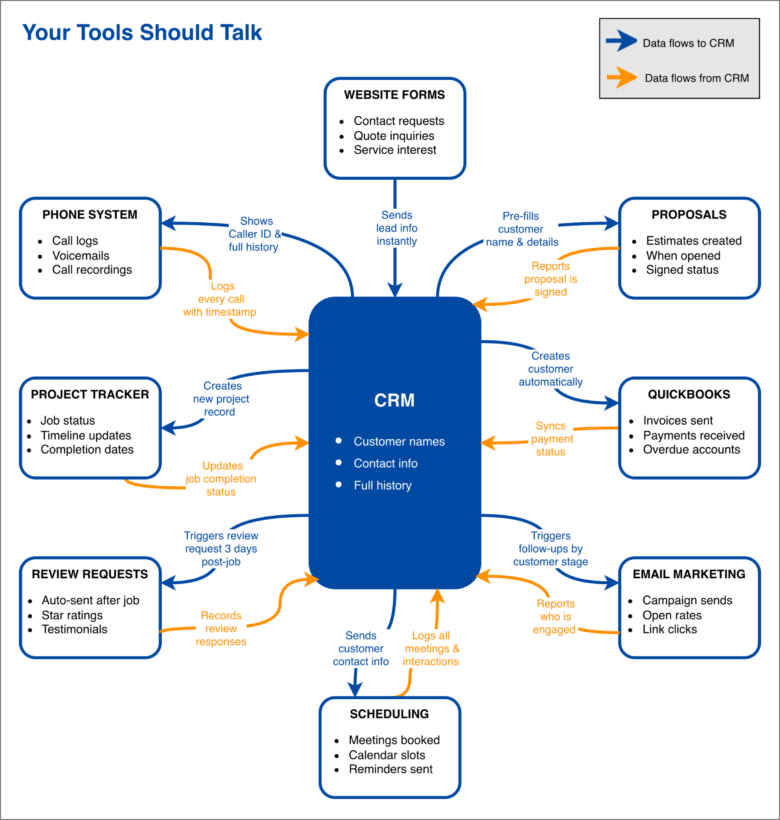
And when your systems talk to each other – when your CRM knows what your accounting system knows, when your proposal tool feeds your CRM, when your email campaigns are based on actual customer behavior – that’s when your business starts running like you always imagined it could.
You Don’t Need the Fanciest Tools
Cris told me a story about hanging curtains. A referral from her networking group. She almost didn’t go – hanging curtains felt like “chump change,” not worth her time.
She went anyway out of courtesy. Turned out the customer was married to a huge real estate developer. Thirty-five years later, she’s still his main cleaner for apartment turnovers, offices, everything.
The lesson isn’t “always say yes to small jobs.” The lesson is: you never know which relationship is going to matter most. Which is exactly why you need a system that tracks them all, nurtures them all, keeps you connected to all of them.
You don’t need Salesforce. You don’t need enterprise software. You just need a system that captures everyone who ever expressed interest in working with you, helps you follow up appropriately, and doesn’t let good relationships die from neglect.
Stop Losing Leads to Your Own Memory
You’re carrying too much in your head. Customer details, follow-up dates, who said what, who needs what. It’s exhausting, and it’s limiting your growth.
Book a 45-minute Discovery Call. We’ll talk about where your leads are going right now – text messages, business cards, memory – and how to capture them in a system that actually works for how you operate.
You bring the stories of customers you wish you’d followed up with. I’ll bring 13 years of building systems that remember so you don’t have to.