
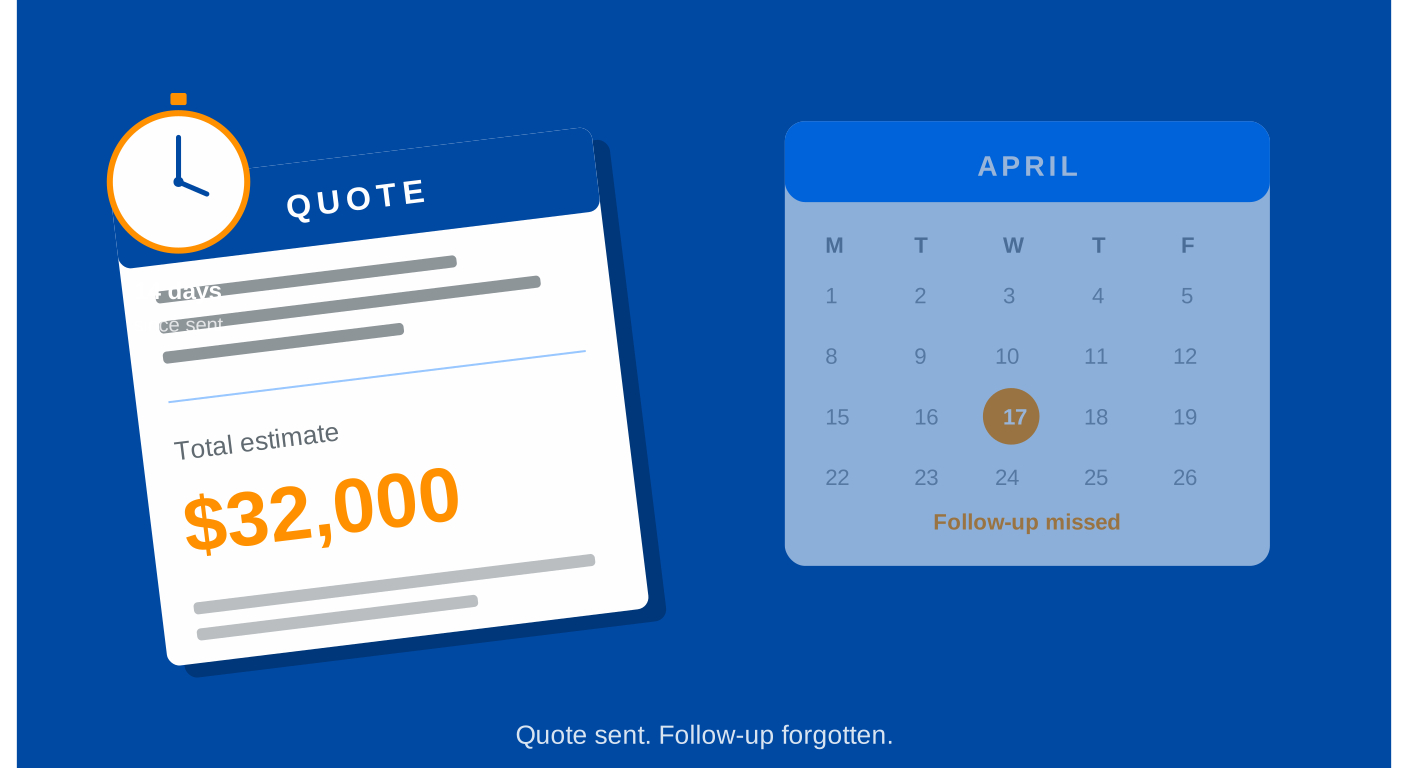
Think about what has to happen for a quote to go out. You have to remember the lead. Write it up. Send it. Follow up when they go quiet. Chase the proof, the revisions, the “did you get my email.” Every one of those steps runs through you, and you’re already stretched thin. So quotes sit. Follow-ups slip. Good jobs stall out because there’s only one of you.
That’s the real cost of being the bottleneck. It shows up as you working nights to catch up, and still watching ready-to-buy prospects drift because nobody got back to them in time.
The Proposal Black Hole
I talked with Diana, a contractor recently who told me her process for sending estimates. She meets with the prospect, takes measurements, discusses the scope. Then she goes back to her office, opens QuickBooks, creates the estimate, exports it to a PDF, attaches it to an email, writes a message, hits Send.
The customer opens it, or doesn’t. She has no idea.
Three days pass. Did they look at it? Was the email flagged as spam? Are they thinking about it? Should she follow up?
A week goes by. Now it feels awkward to reach out. Maybe they went with someone else. Maybe they’re just busy. She doesn’t know, so she does nothing.
The prospect moves on. The process gave them too much time to cool off, too many chances to forget, and too many openings for the competitor who got back to them faster.
Take Sam, who runs a printing and promotional products company. He landed a $32,000 order, a huge win, especially in a slow season. Then he spent 30 hours on proofs. Back and forth with the customer. Logo tweaks, color adjustments, text placement, email after email, revision after revision. By the time those 550 pieces went to print, Sam had basically worked for free on the biggest job of his year. He’s good at his trade. The problem was that every step of the approval ran through him, by hand, with nothing tracking where it stood.
That’s the black hole. When the whole proposal process lives in your head and your inbox, quotes sit and hours pile up behind you.
What Speed Actually Buys You
You’ve heard “strike while the iron is hot.” The moment someone decides they want to work with you is the moment they’re most excited. Every hour that passes after that meeting, their enthusiasm drops. Other priorities pop up. Doubts creep in. Your competitor calls them back.
When Diana sends estimates through QuickBooks, customers can approve them right there, one click, done. She told me she usually hears back the same day. But she’s still guessing, because she has no idea if someone opened it and didn’t approve, or never saw it at all.
Compare that to modern proposal tools that tell you:
- The second they open your proposal
- How long they spent reading each section
- If they shared it with anyone else
- When they come back to look at it again
Suddenly you’re not guessing. You’re not playing phone tag. You know exactly when to follow up because you know exactly when they’re thinking about you.
The Real Power Is What Happens Next
But most business owners stop short.
Let’s say the customer approves your proposal. Great. In most businesses, that’s where the proposal tool’s job ends. Now someone has to manually:
- Create them as a customer in your accounting system
- Set up the project in a CRM like Zoho CRM or HubSpot
- Add them to your “New Customer Welcome” sequence
- Update your pipeline report
- Schedule the first follow-up
Each of those steps is a place where things fall through the cracks. Each one is time you’re spending on administration instead of the actual work. And each is a chance to look disorganized to your new customer.
What if the second they signed, all of that just happened?
Customer gets automatically created in QuickBooks, correct spelling, correct email, correct phone number. Your CRM knows they’re no longer a prospect, they’re active. Your welcome sequence starts. Your pipeline updates itself. You get a notification to schedule their kickoff.
You look like a well-oiled machine because you are one.
From Chaos to Closed
I’ve watched too many skilled professionals lose jobs they should’ve won because their proposal process had too much friction, too many steps, too much time between “yes, I want to work with you” and “here’s how we move forward.”
I’ve also seen owners like Sam spend profitable hours doing unprofitable work because there’s no good way to manage revisions, approvals, and sign-offs.
This is about making sure the software you already have, or could easily afford, actually moves deals forward instead of letting them stall in your inbox.
Your Proposals Should Work As Hard As You Do
When we talk on a Discovery Call, one of the first things I’ll ask is: “Walk me through what happens after someone says they want a quote.” I’m listening for the gaps, the places where you’re doing manual work a system should handle, the moments where momentum dies because the handoff isn’t smooth.
Then I’ll show you exactly how to fix it, with tools you probably already have, set up in a way that actually makes sense for how you work. No enterprise software or six-month implementations. Just a proposal process that closes deals while they’re hot instead of letting them go cold in the gap between “I’m interested” and “here’s your paperwork.”
Book a free Discovery Call. Bring your stories about proposals that took too long, estimates that disappeared, or quotes that stalled waiting on you. We’ll map out exactly where your process is stalling, and how to hand that work to a system instead of carrying it yourself.